-1920w%20(1).webp)
If your vision has become cloudy or hazy months or years after cataract surgery, you most likely have a common, easily treated condition called posterior capsule opacification (PCO) — not a returning cataract. You did everything right. You had your cataract surgery, recovered well, and enjoyed the clear vision you'd been missing. Then, months, or even a couple of years later, things start looking hazy again. Colors seem muted. Headlights have halos. You're squinting at things you could read easily before.
Before you worry that your cataract has come back, there's something important to know: cataracts cannot return once they've been removed. What you may be experiencing is something called posterior capsule opacification (PCO) and the good news is that it's common and very easily treated.
During cataract surgery, your surgeon removes the cloudy natural lens from inside your eye and replaces it with a clear artificial lens called an intraocular lens, or IOL for short. That IOL is gently positioned inside a thin, clear membrane called the lens capsule. This is basically a natural "pocket" that holds everything in place.
Over time, residual cells from the natural lens can multiply and grow on the posterior capsule (the membrane at the back of the lens) causing it to thicken and become slightly opaque. When this happens, the capsule can become cloudy or wrinkled, causing blurry vision. This is called posterior capsule opacification, and it's sometimes referred to either as a "secondary cataract" or "scar tissue."
It's not a cataract and it doesn't mean that something went wrong. PCO is considered the most common postoperative complication of cataract extraction, and it can happen to anyone who has had cataract surgery, regardless of how successful the original procedure was.
Clouding of the lens capsule is more common than most patients realize. About 20% to 50% of patients will deal with posterior capsule opacification within 2 to 5 years of their cataract surgery. PCO can be noticeable to the examining doctor within days of surgery, but it can also be delayed months or years. It more frequently affects younger patients.
Symptoms to watch for include:
If any of these sound like your experience, it's time to schedule an appointment with your eye doctor.
The treatment for PCO is called a YAG laser capsulotomy (also known as a posterior capsulotomy), and it is about as far from your original cataract surgery as a procedure can get. YAG laser capsulotomy is a quick, simple follow-up procedure that uses a special laser to treat posterior capsule opacification. It's safe, effective, fast, and painless.
Here's how it works: your ophthalmologist uses a specially-designed laser that makes contact behind the IOL to make a small opening in the cloudy lens capsule. That opening allows light to pass through clearly again, restoring the sharp vision you had right after your original surgery.
This is the question we hear most often, and the differences are significant:
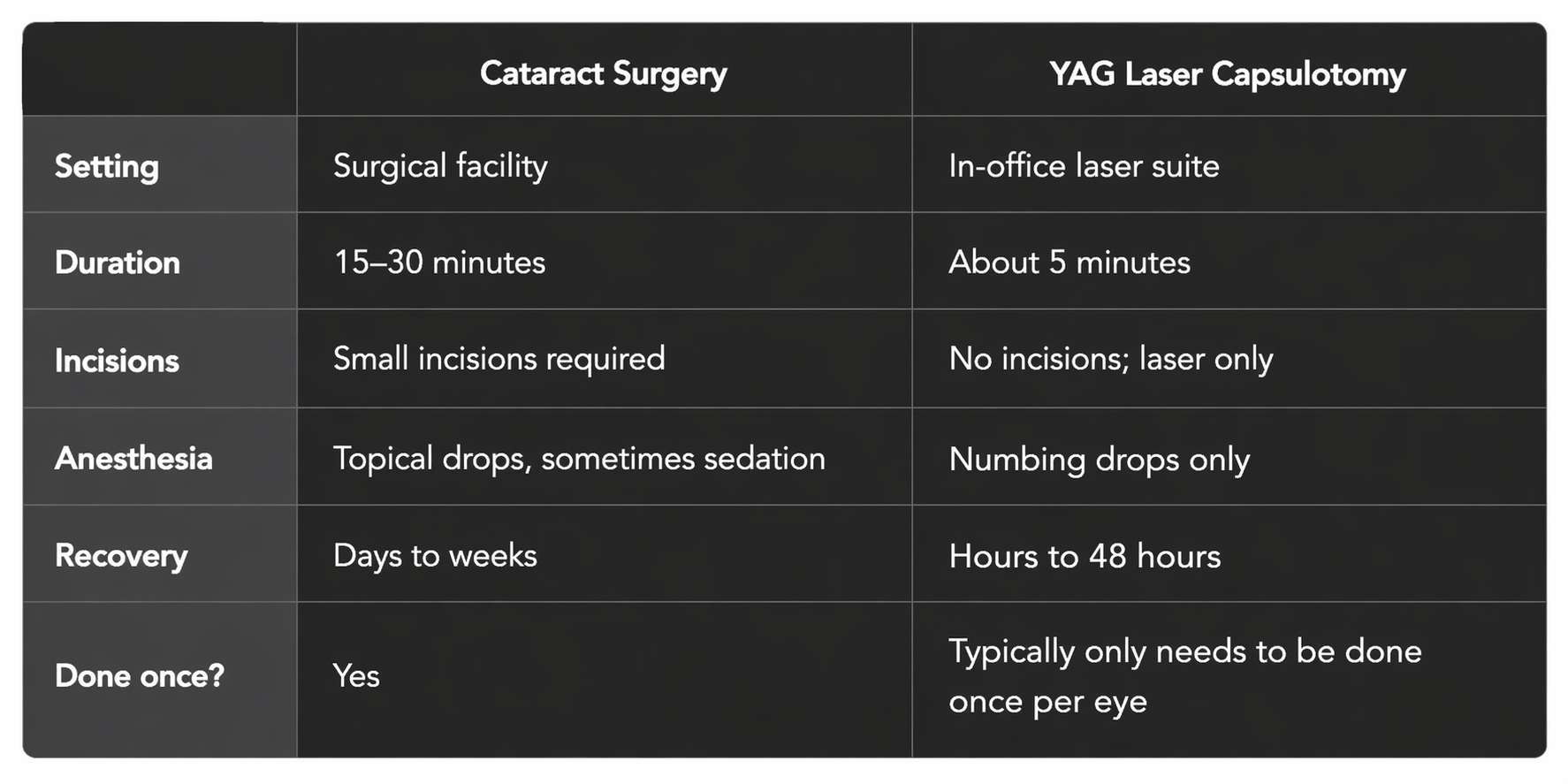
Cataract surgery is a true surgical procedure and is performed in an accredited surgical facility. At Texas Eye and Cataract, our patients have access to our brand-new, state-of-the-art Everest Surgery Center in Midlothian — one of the most advanced ambulatory surgery centers in Ellis County, built specifically to deliver the highest standard of surgical care close to home.
The YAG laser procedure, by contrast, is performed in a specially-designed room on the clinic side of our office. When you arrive, a technician will measure and dilate your eyes. In the laser room, you'll sit at the laser slit lamp, similar to the microscope used during a regular eye exam. Your doctor will give you numbing eye drops, then use a special lens to focus the laser on the scar tissue surrounding your implant. You may hear small clicks or pops as the surgeon creates the opening, but the procedure is generally painless and is completed in a matter of minutes.
Most patients notice an improvement in their vision within 24 to 48 hours of the YAG laser capsulotomy. This procedure results in improved visual acuity in 83% to 96% of eyes. You may notice a few new floaters right after the procedure, but don't worry! These are normal and result from the laser breaking up the capsule tissue; they typically resolve within a few days.
You'll want to arrange a driver for your appointment, since your eyes will be dilated. Most patients return to normal activities within a day.
Contact our office right away if you experience:
These could be signs of a rare complication called retinal detachment, which requires prompt attention.
Don't worry if you're noticing mild clouding of your vision after cataract surgery. PCO is a natural part of how the eye heals after surgery and the YAG laser has been the gold standard treatment for decades. YAG laser capsulotomy introduced a technique for bladeless, effective, and safe treatment of the opacified posterior capsule and rapidly became the standard of care.
At Texas Eye and Cataract, we're proud to be a locally owned and operated practice rooted in Ellis County — serving patients in Midlothian, Waxahachie, Mansfield, Cedar Hill, Duncanville, and surrounding communities. As a member of the Baylor Quality Alliance and Texas Health Resources, and active participants in both the Midlothian and Waxahachie Chambers of Commerce, our commitment runs deeper than eye care; we're invested in the long-term health and growth of this community. When something doesn't look right after your cataract surgery, you deserve answers from a team that knows you, not a crowded referral center hours away.
If your vision has turned hazy or cloudy after cataract surgery, your cataract has not returned — cataracts cannot come back once removed. What you're most likely experiencing is posterior capsule opacification (PCO), a common condition where the membrane behind your lens implant becomes cloudy over time. The fix is a quick, painless, in-office laser procedure called a YAG laser capsulotomy that takes about five minutes and typically restores clear vision within 24 to 48 hours.
No. Once a cataract is surgically removed, it cannot return. If your vision becomes cloudy again after cataract surgery, the most likely cause is posterior capsule opacification (PCO), which is a separate and easily treatable condition.
What is a YAG laser capsulotomy?
A YAG laser capsulotomy is a quick, painless, in-office laser procedure used to treat PCO. Your doctor uses a specially-designed laser to create a small opening in the cloudy lens capsule, restoring clear vision. The procedure takes about five minutes and requires no incisions.
How long does it take to recover from a YAG laser procedure?
Most patients notice improved vision within 24 to 48 hours. You may experience a few new floaters immediately after the procedure, but these typically resolve within a few days. Most patients return to normal activities within a day.
Is PCO serious?
PCO is not dangerous, but it does affect your quality of vision and should be treated. Left untreated, the cloudiness can continue to worsen. The good news is that treatment is simple, quick, and highly effective.
When should I call my doctor after a YAG laser procedure?
Contact your doctor right away if you experience a sudden increase in floaters or flashes of light, a shadow or curtain moving across your vision, or a significant reduction in vision after the procedure. These could be signs of a rare complication called retinal detachment that requires prompt attention.

Share this on social media
You May Also See


The most practical gifts are preservative-free artificial tears, wraparound sunglasses, audiobooks or a podcast subscription, meal delivery, button-front or zip-front pajamas, a warm eye compress mask, and a drop or medication organizer. Offering your time for rides, errands, or company is also one of the most appreciated gifts of all.
Avoid heavily fragranced flowers, gifts that require lifting or assembly, eyedrops that are not preservative-free, and fitness or exercise-related gifts. These either pose a physical risk during recovery or aren't appropriate until the patient is cleared for full activity.
Most patients return to normal daily activities within a few days to a week. Restrictions on bending, lifting, and swimming typically ease within two to four weeks, and most patients are fully back to normal routines by the one-month mark.
Raising the arms overhead to pull on or remove a shirt can accidentally bump or put pressure on the operated eye during early recovery. Button-down or zip-front tops are a safer, more comfortable choice for the first week.
Screen time is generally recommended to be limited for the first one to three days after surgery, as it can cause eye strain during early healing. Audiobooks and podcasts are a great alternative during this period.

When it comes to eye care, identifying and understanding the differences between an optometrist ...

Vision is a priceless gift, allowing us to perceive the world, appreciate its beauty, and navig ...

This guide offers practical strategies and valuable insights for those seeking a proactive...
A cataract is an eye disease that causes the lens of the eyes to become cloudy, leading to blurry...

MIGS, short for Minimally Invasive Glaucoma Surgery, and Durysta implants are two of the most ...

At Texas Eye and Cataract, we know how important it is to see life with clear vision. We understand that being your best means seeing your best.
At Texas Eye and Cataract, we know how important it is to see life with clear vision. We understand that being your best means seeing your best.

